Shifts at Snagajob
Shifts is Snagajob's marketplace for hourly work, where an employer posts a shift and a nearby worker claims it. As the only designer on Shifts, I researched, designed, and shipped employer self-signup, talent pools, and a remote check to verify that a worker is legally allowed to work.
- Product Design
- UX Research
- Identity
The problem
When I joined, the Shifts team had gone about a year with no designer and no product manager. Decisions still got made, but nobody was checking them against the employers posting shifts or the workers claiming them, and finished design work was sitting unbuilt. I came to Snagajob as an intern and left running my own initiatives. On Shifts, I was the only designer, embedded with the engineers, so each piece of work was mine from the first interview through the build to the release.
The work
Employer self-signup
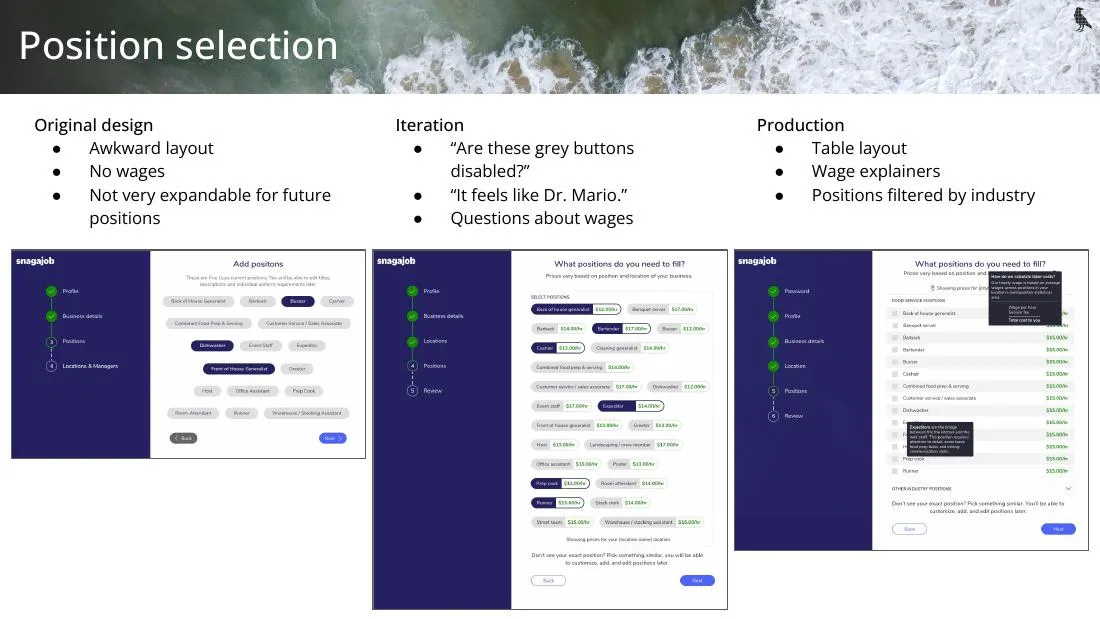
The first thing I picked up was a self-signup flow a previous designer had drawn but never built. Before it went to engineering, I tested it with 10 small-business owners. They told me plainly that the flow was too long, that the position-selection page confused them, and that they balked at entering payment before they had asked for a single shift. One owner said the page of colored pill buttons felt like Dr. Mario. I cut the flow down, rebuilt positions as a table with wages and an industry filter, and moved payment past the point where the value was obvious. Then we built and shipped it.
Talent pools
An unfilled shift costs a manager money, and the workers they trust most are usually the ones already on their payroll. I designed the bulk invites, invite emails, worker notifications, and onboarding that let a manager gather their own seasonal workers into a pool and send open shifts straight to it.
The remote I-9
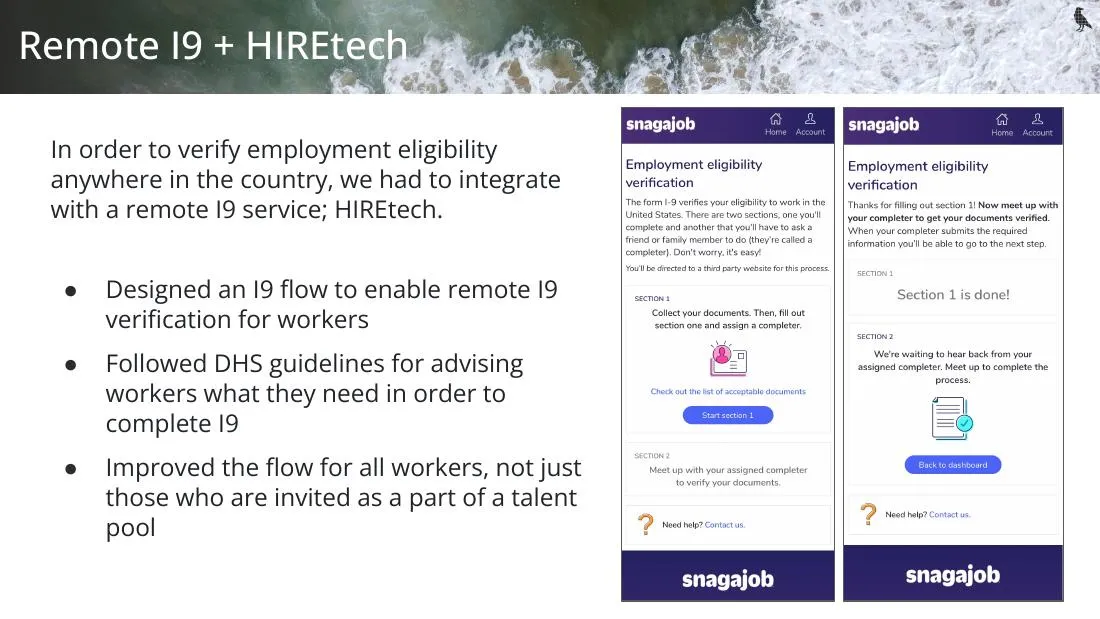
To put a worker on a shift anywhere in the country, we had to verify that the worker was legally allowed to work there, and Snagajob had no physical presence in most of those cities. I designed a remote I-9 flow on an integration with HIREtech, written to Department of Homeland Security guidelines, that told a worker which documents to gather and walked them through each step on a phone. I tested the wording with 10 location managers and 10 hourly workers, in a cognitive walkthrough and an unmoderated round. The remote I-9 was the first identity verification I ever designed.
What changed
By the time I left, an employer could set themselves up on Shifts and post work, a manager could fill a shift from the workers who already worked for them, and a worker could be verified for a shift in a city where Snagajob had no office.
I also set up a charter-customer program, a standing group of employers who met with me every two weeks, so their feedback arrived on a schedule rather than by accident. When COVID closed the stores and warehouses where we had recruited workers in person, I moved that research to the phone and kept it running. With no product manager on Shifts, I ran a standing meeting to carry what we heard to operations, support, and marketing.